From Exploratory Research to Actionable Insights
In 2022, I led a qualitative, exploratory research project to support Mind & Life’s organization-wide strategy for engaging young adults (ages 18-30). The evaluation involved two phases of research: first, an exploratory study of the client’s young adult audience to understand their pain points and motivations for engaging with Mind & Life’s services, and a second phase to develop ongoing and future strategic actions to engage this audience.
Client: Mind & Life Institute
My Role: Project Lead
Timeline: June 2022-February 2023 (11 months)
Phase 1: Exploratory Audience Research
Research Methods:
I facilitated remote 20+ one-on-one interviews with current and potential members of the target audience.
I facilitated two remote focus groups; one each with adults aged 18-24 and 25-30.
Findings:
The audience research both provided new information for the client and confirmed many of their preexisting ideas.
Mind & Life's 18-30 audience is global and far-reaching, and are often in states of transition.
Young adults appreciate the resources provided by Mind & Life, but feel there can be a greater focus on advocacy, action, and ideas related to decolonization and materialism.
The findings confirmed for Mind & Life that this audience is eager to connect with each other as well as with the larger Mind & Life community.
They are hungry for mentorship and guidance around pursuing their activism and connecting their contemplative practice to their changemaking activities.
Mental health, climate change, and equity for marginalized communities are top-of-mind issues for this group.
“I think that this country [USA] is on fire and as a Black woman, as somebody who works in mental health and sees poverty all the time and how mental health is not accessible, I think it’s really easy to get so disappointed and so disillusioned and ask those big existential questions of like, why am I here? What am I doing? But mindfulness, I think really helps me to reenter. So, for me, I look at it as a tool of grounding and of not feeling like I have to take everything on and it is like a safe space. It’s a refuge when it feels like everything around me is in disarray and chaotic and I can’t make sense of it. It’s like a soft place to land.”
See the complete audience research report for more details from this first exploratory phase, where I synthesize data from 22 hour-long interviews and two focus groups that I conducted myself, and present recommendations to help Mind & Life discover areas of alignment between its offerings and participant needs.
Phase 2: Strategic Action Plan
Building from what we learned from the audience research phase, I facilitated a series of five visioning sessions to support Mind & Life in defining components of a logic model (see below) that would serve their strategic goals for young adults.
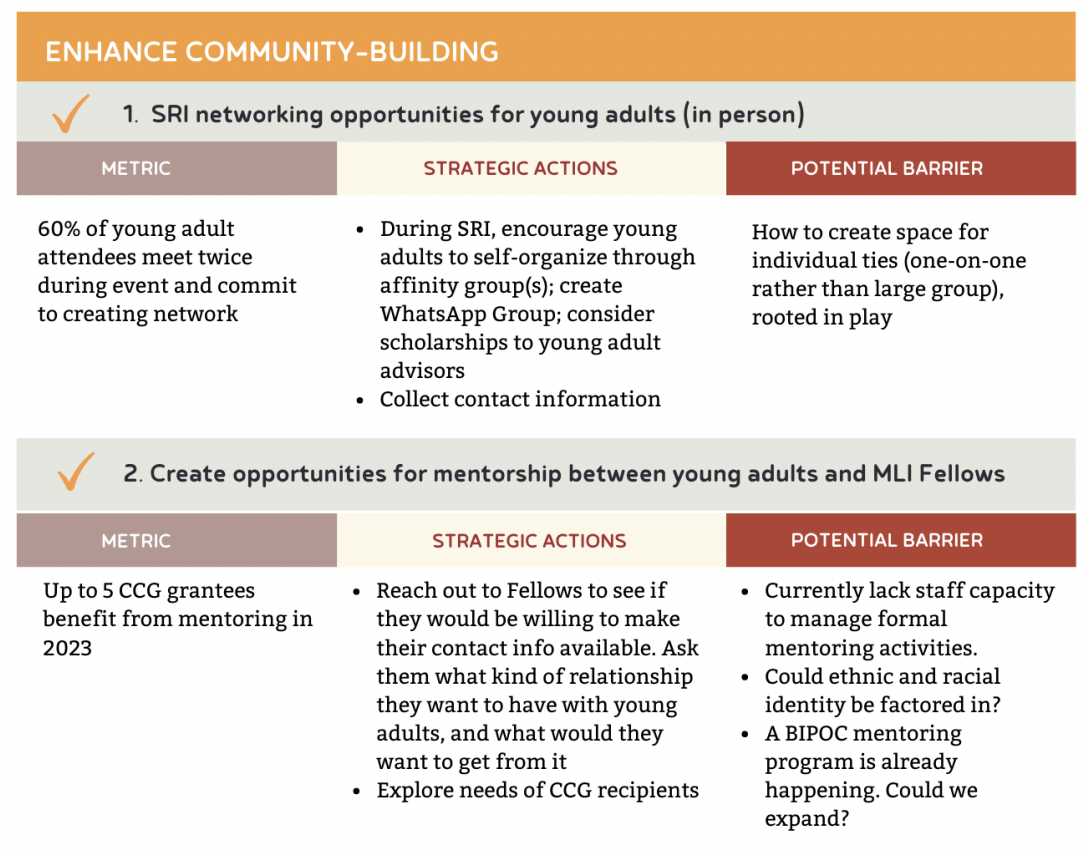
The logic model helped me co-develop an action plan with the client to support their immediate first steps to achieving their intended outcomes. For example, to support this audience's desire for mentorship and community, I developed short and mid term outcomes, measurable metrics, and corresponding action steps Mind & Life can take to enhance community-building.
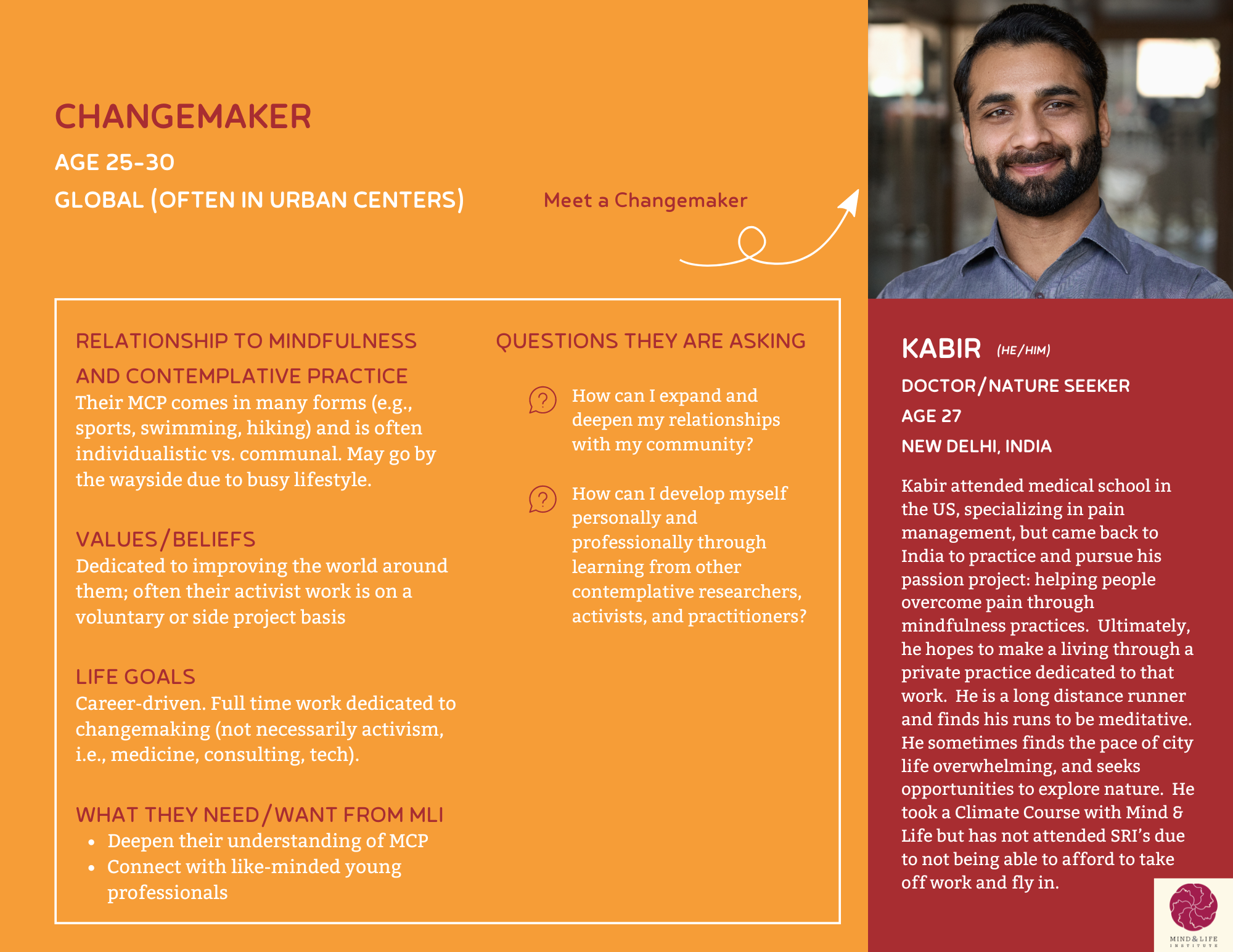
I also developed personas for the client, designed to help them program with specific audiences in mind.

Reflection
I’m proud of the analysis and the trauma-informed approaches I implemented, such as sending the interview questions in advance to the participants; this was a decision I made in response to several participants describing trauma and/or burnout as the main motivation behind beginning in their mindfulness practice.